
Hello friends,
Today’s topic is the future, specifically the upcoming future, which is poised to become the hot tea of the “present era.” Yes, I am talking about Artificial Intelligence, and in particular, I will focus on a commonly famous aspect these days – Generative AI. Let’s delve into what Generative AI is, why it’s currently in the spotlight, and the significance of this intriguing topic.
First let’s get something about Machine Learning..
Machine Learning is a Subset of AI, where you develop algorithms and prepare statistical models to enable computers to learn from data and improve their performance on a specific task without being explicitly programmed.
ML is categorized into 3 types:
- Supervised Learning: Algorithms is trained on labelled dataset, related tasks such as : image classification, speech recognition, and regression tasks.
- Unsupervised Learning: the algorithm is given an unlabelled dataset and must find patterns and structures within the data on its own. tasks include clustering, anomaly detection, and dimensional reduction.
- Reinforcement Learning: Reinforcement learning is a type of machine learning where an agent interacts with an environment to learn how to achieve a goal. The agent receives feedback in the form of rewards or penalties based on its actions, and it learns to take actions that maximize the cumulative reward over time. Reinforcement learning is widely used in areas like robotics, game playing, and autonomous systems.
What is Generative AI ?
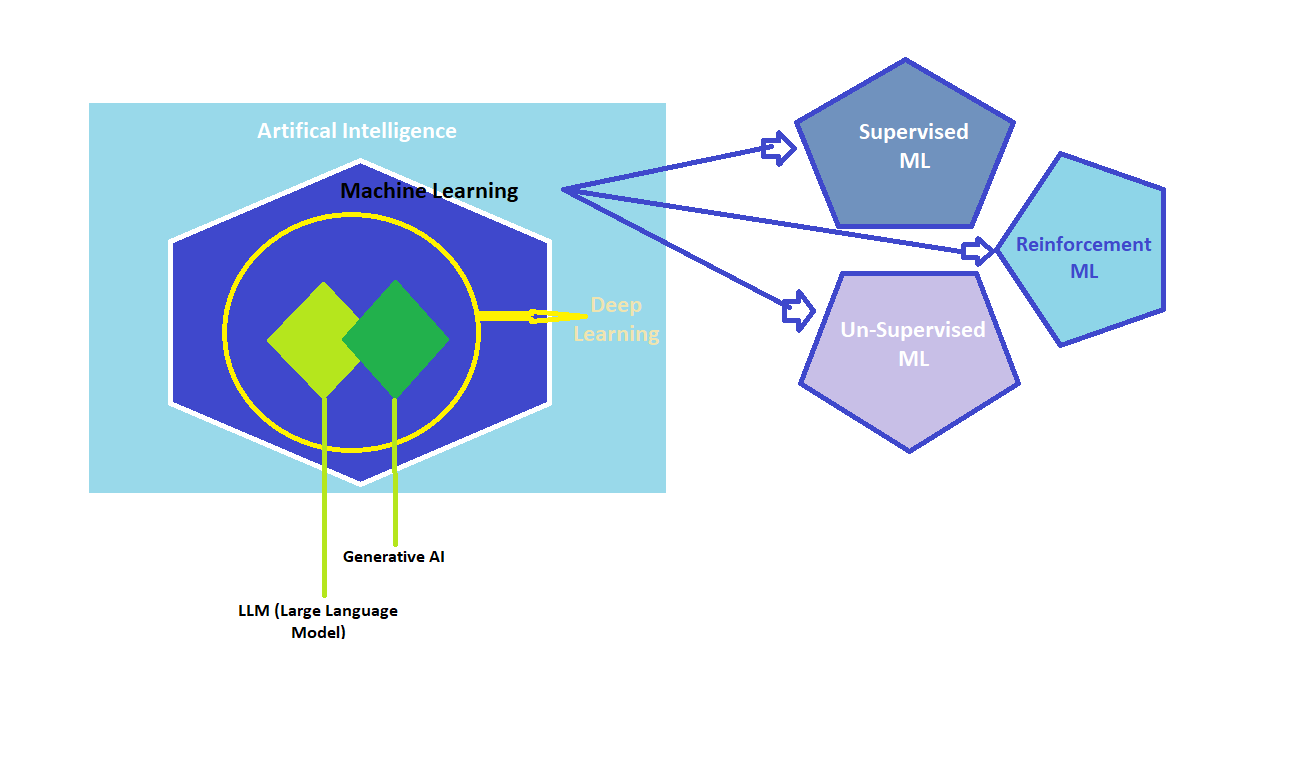
you can see the picture above as it is the subset of Deep Learning. It involves training models to generate new data that resembles existing data. Unlike other AI models that focus on recognizing patterns or making predictions based on existing data, generative AI aims to create new data that didn’t exist in the original dataset.
let’s talk a little about LLM model which is Large Language model are used for a wide range of applications due to their ability to understand and generate human-like text.
some specific examples of how LLMs have been used: Chatbots and Virtual Assistants, Language Translation, Text Summarization, Content Generation, Language Programming, Question Answering, Creative Writing and Poetry, Text-Based Games, Language-Based AI Art, Language Learning and Tutoring, Personalized Content Recommendations, Medical and Legal Analysis, Language-Based Accessibility.
Now here it is also a subset of Deep Learning as well as the Generative AI. both LLMs and Generative AI models share the ability to generate new data, but they have distinct focuses and applications within the broader field of artificial intelligence.
Deep Learning can be categorized into two parts:
Discrimination Techniques and Generative Techniques.
In Discrimination Techniques, the focus is on performing tasks like classification and prediction based on datasets that are trained on labeled data. These models use labeled data to learn the patterns and features that distinguish different classes or categories. On the other hand, Generative Techniques involve tasks that generate new data, such as creating new music, images, or sentences, based on training data that is similar in nature. In this case, unstructured datasets are provided, and no supervised or unsupervised learning is involved.
A prominent example of Generative AI is ChatGPT, which is a generative language model capable of generating human-like text. Another notable example is DALL-E, a generative image model.
Now it is important to know where does this Generative AI fit ?
Generative AI fits within the broader domain of Deep Learning as a subset, and it involves using vast amounts of data available over the internet. These models utilize deep learning techniques, such as neural networks, to generate new data that resembles the patterns and characteristics of the training data.
For an example:
In the realm of music, you can find two types: rock and classical. For each type, you have labeled data that represents various details of the music, such as rock, romantic, or classical.
In the Discrimination Model, this labeled data is utilized for prediction purposes. The model can represent and categorize music based on its characteristics. For instance, it can identify if a piece of music belongs to the rock, romantic, or classical genre.
On the other hand, in the Generative Technique, new data is created. This means generating entirely new music, new tones, or even completing unfinished music. Additionally, it is possible to write a new story by making educated guesses about the topic.
Suppose you have unstructured content and pass it through a Generative AI Model. In this scenario, the model learns patterns and distributions from the unstructured content. It may require the assistance of other techniques and supervision to create new content. The model can produce various forms of data, such as images, text, audio, video, and more.
To differentiate the output and confirm that it is related to Generative AI, the model examines whether the output is related to new content generation, rather than dealing with numbers, classes, probabilities, or categories. If the output pertains to numbers, classes, probabilities, or categories, it is not considered Generative AI.
In Machine Learning, you provide a diverse set of features to train a model, aiming to generate a relevant output. On the other hand, in Deep Learning, the emphasis is on using predictions based on labeled data to analyze and create new datasets, such as generating new text, images, audio, and videos.
Imagine this scenario: I provide you with a book and allow you to utilize a Generative AI model to scan it. The Generative AI model will summarize the book and deeply formalize its content. As a result, you’ll have the ability to generate any question from the book and receive quick responses based on the deep analysis performed by the model.
In Summary: Machine Learning relies on diverse features to create models, while Deep Learning uses predictions and labeled data to generate new content, and with Generative AI, you can leverage sophisticated models to summarize and deeply understand the book’s content, enabling the rapid generation of relevant questions.